Wednesday, 7 January 2015

The Music Industry: Record Labels


The music industry has four main multi-national corporations which lead the whole industry. Rising artists aim to get recognition from these label to ensure success.


Universal Music Group

Eminem


Jessie J


Taylor Swift


Sony Music 

Beyonce


Miley Cyrus


Little Mix


Warner Bros 


Hunter Hayes


Jana Kramer


Birdy


Major Independents 

Island records

Alex Clare


Alexa Goddard


Aluna George


Roc Nations

Andrea Martin


Arlissa


Ben Harrison


Syco Records

One Direction


Leona Lewis


Susan Boyle


Virgin Records 


Ella Eyre


Bruno Major


Bastille


Independents

Domino Records


Monday, 5 January 2015

Narrative Theory: Barthes and Propps


All texts are complex “bundles,” of meaning according to Bathes, they can also reveal many more meanings. They can be open, closed or polysemic.
Open texts have “threads to pull,” often the endings are vague, such as Christopher Nolan’s Dark Knight Rises and Inception. The audience are left unsure on the protagonists’ survival.
Closed texts have one thread to hold, which is clear and most films tend to opt for a closed text ending. For example “a Cinderella Story” has a happy ending, like most Hollywood films. However, some parts of Hollywood are trying to become more indie, like the film “Like Crazy,” which is can be either labelled as a closed text. On the other hand, it can also be named a polysemic text because the ending can be read in a number of ways; it forms several interpretations. Another example of this is “Scarface,” it  can be either read as a “rags to riches,” story, a glorification of violence, a critique of the values in the 1980s, greed and consumption.


The “threads,” are narrative codes. The enigma code comes under the narrative codes which is used a a way to attract and maintain the attention of the audience. A mystery, or a puzzle is created in order for the audience to attempt to formulate a judgement. Commonly, it is introduced in the disruption phase of Todrov’s narrative model.


Barthes’ theory can be applied to all music videos. A clear example of this is Eminem’s Stan video mentioned in my previous post. There is an ending which is clear to the audience when Stan drives into a river. Him, and his partner are killed. The audience knows that they are definitely dead by the camera revealing a scene in a cemetery, followed by a news report.
Vladimir Propps studied folk stories and identified eight main character roles. This does not limit the amount of characteristics in one character. In “Big Momma’s House,” Martin Laurence plays a mother figure, father figure, the donor and protagonist.


The Hero (Protagonist)
The Villain (Antagonist)
The Donor (Provider)
The Helper (Assistant)
The Father Figure (Gives advice and important information)
The Dispatcher (Sends hero on the missions)
The Princess
The False Hero

Star Wars

The Hero - "Luke Skywalker/Han Solo"
The Villain - "Darth Vader"
The Donor - "Obi-Wan Kenobi"
The Helper - "R2D2, C3PO, Chewbacca"
The Father Figure - "Obi-Wan Kenobi"
The Dispatcher - "Princess Leia"
The Princess - "Princess Leia"

The False Hero - "Han Solo"


Saturday, 3 January 2015

Narrative Theory: Syd Field and Claude Levi-Strauss

The Three Act Structure 


Syd Field, a writer labelled the sctructure as “three acts” in Hollywood films


The Setup is the first act which occurs within around 30 minutes of the film before the “plot point,” which normally gives the character a goal to achieve. This can be compared to Todrov’s theory when it comes to the process of disruption in which the enigmas are created. An example of this is Eminem’s “Stan” featuring Dido, the first plot is when Dido discovers Stan’s basement, filled with Eminem poster and pictures. At this point, enigmas are created and the protagonist goal or aim is to get a response from Eminem himself.

The Confrontation is the second act where the character’s struggle must take up half of the running time, in Eminem’s music video, the character writes another letter to his idol. On the other hand, Field suggests that there is “mid-point.” This is a subtle turning point of the confrontation such as a reversal fortune for the character. Stan becomes aggravated as the fan mail goes missing.

The Climax happens in the last quarter, which is also referred to as the third act. This displays the climax of the protagonist, which is either them achieving their goal or not. This illustrates the aftermath of the struggle, if it ends this way then it would be labelled as a closed text according to Barthes. At the end, Stan in rage, yells at Dido and drives the car into a river.


Claude Levi-Strauss and Binary Oppositions

Levi Strauss stressed that the narrative’s structure relies on binary oppositions. There is a conflict between the dominant, and subordinate.


Dominant

Middle-aged
Men
White
Middle/upper clas
Able-bodied
Regional identity 
Heterosexual

Subordinate

Young/old
Disabled
Working class
Women
Regional identity, other than London
Homosexual
Ethnic groups


Stan is a white, able bodied and heterosexual which is displayed rather powerfully in contrast to Dido, although she is white she is a woman, therefore subordinate. Dido is pregnant, and we presume that he is the father, therefore he is automatically the “man of the house.” He also seems to emotionally manipulate her, getting into arguments and making her cry. She hasn’t got a piece of mind as he puts his obsession over his priorities, Dido and the baby. He is almost always in control, despite committing suicide in the end. Stan loses control as the music video carries on, leading him to his tragedy. It is arguable whether, Eminem himself is the completely in control. He also falls under the characteristics of someone who belongs in the dominant group, especially because he is a famous, wealthy white a male. Stan’s obsession exemplifies how someone in a dominant group can have power of someone who is inferior to them. As soon as Stan became a fan, his obsessive nature controls his actions.

Thursday, 1 January 2015

Styles of Music Video

Narrative 

When a music video follows a certain storyline is called a narrative based music video. It is common to do in the music industry, it helps the audience relate and engage with the meaning of the song. Romantic songs usually take up this stance.


The music video follows young love to adulthood.  Having the same colour eyes perhaps represents how they are soul mates, connected on a deeper level.  The female sings not just love, but resentment and pain… “I don’t wanna fall in love.” This song is like the after effect of heartbreak, and betrayal. The woman who the male sleeps with towards the end becomes an object of desire, “its strange what desire can foolish people do,” which was the ultimate downfall of the relationship.  Visually seeing this encourages the audience to relate and sympathise with the main female. The other female somehow looks like she cannot be the one the man loves, but succumbs to sleeping with him anyway. The man tries to grab the woman he loves, but she breaks away. She lets go – she wants to detach herself from love.


Cinematic 

Cinematic has a similar approach to narrative but there is a film quality to it. Often, there are clips of a movie incorporate into the music video to make it look more realistic. An example of this Eminem's lose yourself.


Studio Based

It's rather self explanatory - music videos based at a studio, most are performed in s stylish way.


Intertextuality 

This is when a music video refers to other texts, "Walks like Rihanna," imitates Back Street Boys and Take that.


Parody


Pastiche


“As Live”


Friday, 19 December 2014

Sexism in Pop Videos

Sexism 

Sexism is the objectification of a gender. In a patriarchal society, women are obejectified, whether it is in movies, music videos or real life. The fact is the media influences us and our way of thinking. It is most likely we will adopt sexist attitudes if we are exposed to sexist behvaiour. For centuries women were considered lower than men. In the 1960s, sexism was shown and advertised; some woman felt that it was the role of a female to subordinate. However, it caused uproars for others. Additionally, the cigarette was a "liberated movement" for women as they were allowed to smoke, on and off screen. It gave women a sense of power, and a taste of freedom to an extent.


p2 


Particular music videos which provoked a rather controversial response are "Blurred Lines," by Robin Thicke and "Wrecking Ball," by Miley Cyrus. They both are clearly different, but both are extremely sexual and provoke ideas of sexism.


Firstly, Robin Thicke's video seems to be encouraging  "good girl," to forget their morals and sleep with him, also TI explicitly explains how he will aggressively have sexual relations with her. It also seems quite creepy, especially when he repeatedly says "I know you want it." In fact, the singers didn't think they were explicit enough with minimally clothed women in their video, they made another video with the three women in flesh coloured thongs and no bra.


The lyrics indicate rape, and overly objectifies women. Oddly, the men are fully clothed - are the men the only one worthy of clothes? The video is degrading to women, and he makes it extremely clear, "People say, 'Hey do you think this is degrading to women 'I'm like 'Ofcourse it is. What a pleasure it is to degrade a woman. I've never gotten to do that before. I've always respected women."It appears he seems to take pride in objectifying women.


Some may find Miley's "Wrecking Ball," as a liberation for women, others may see her self moving towards the anti-feminst route. One of the "liberated woman" movements is being braless. They are described as "male contraptions." She is crashing the walls around her, perhaps she feels trapped and sees the way she dresses as an expression of freedom. Miley wants other females not to be ashamed of their bodies. However, others have found it disturbing and pushing boundaries as she licks objects and swings on a ball. It could be argued that the video is meant to spark controversy, and is meaningless. 


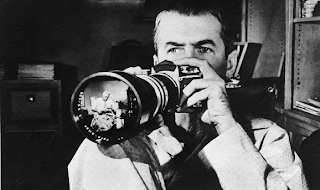
Laura Mulvey said that the “male gaze,” dominates the media world. It is a well-known, and discussed theory. The audience is constantly put in the perspective of a heterosexual man. A scene is normally decimated to the shape of a woman’s body. It is seen in movies, as well as music videos. It is used intensely in rap music videos in general. It may be seen as a way of glorifying the curvy female body which was once condemned before. However, most feminists beg to differ. They see this an a way of objectifying women, as if they were a piece of meat. 


There are deliberate camera movements which deny the woman’s human identity. The physicality is solely concentrated on. Also, 16% of movie makers are female which means most of the time we will see the footage from a male’s perspective. Female leads are rare, if they are present, they are mostly objectified; wearing less clothes. We live in a hegemonic society where the male is a dominant figure of society.